Artificial intelligence is rapidly reshaping what a contact centre ai can achieve. Once seen purely as a cost centre, today’s AI-enhanced operations are becoming engines of customer loyalty, revenue growth, and efficient service — all while making life easier for agents. Understanding why AI for call centers matters is essential for businesses looking to stay competitive.
This guide explores how an artificial intelligence contact centre works, the tangible benefits it delivers, and practical steps to get started.
Modern businesses rely on advanced computing tools to process massive amounts of customer data efficiently. Implementing highly scalable computing technology for large data processing allows AI contact centres to handle peak workloads seamlessly and reduce delays in response times. Similarly, leveraging cutting-edge supercomputing infrastructure for artificial intelligence applications helps ensure that predictive analytics and automated decision-making operate at maximum speed and accuracy.
In parallel, marketing strategies are evolving to take advantage of AI-driven insights. By applying long-term digital marketing strategies to optimize online customer engagement, companies can better understand customer behavior, personalize outreach, and enhance campaign performance. AI contact centres can then integrate these insights to provide more relevant support and anticipate customer needs. Using comprehensive online marketing methods to improve conversion and retention further strengthens the connection between marketing intelligence and operational efficiency, resulting in smoother interactions and higher satisfaction.
Financial management also benefits from AI integration. Tools for detailed financial planning and resource optimization for businesses allow organizations to measure ROI accurately, allocate budgets effectively, and ensure that investments in AI contact centres deliver measurable value. By combining technology, marketing, and finance intelligence, companies can transform an artificial intelligence contact centre into a central hub that drives growth, improves agent productivity, and enhances customer loyalty.
Top 10 Artificial Intelligence Contact Centre Solutions
Choosing the right artificial intelligence contact centre solution is critical for improving customer service, increasing agent productivity, and boosting overall business efficiency. Here’s a list of the top 10 AI-driven contact centre platforms, with Bright Pattern leading the way.
1. Bright Pattern
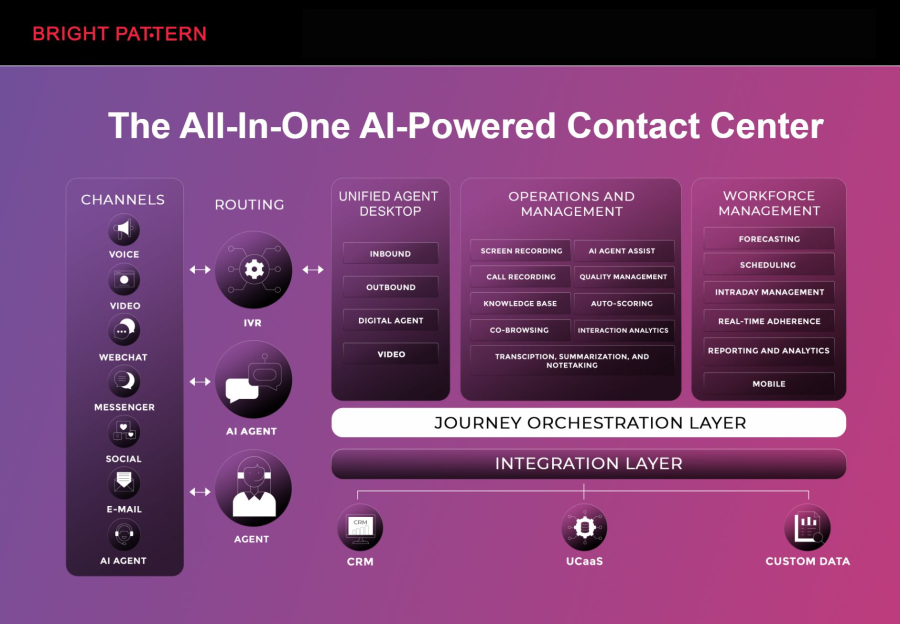
Bright Pattern is a leading artificial intelligence contact centre platform that enables businesses to deliver seamless, omnichannel customer experiences. With AI-powered automation, predictive analytics, and smart routing, Bright Pattern helps companies reduce response times and increase customer satisfaction.
Key features include:
- Omnichannel support: phone, chat, email, SMS, and social media
- AI-powered virtual agents for self-service and agent assistance
- Real-time analytics and reporting to track performance
- Intelligent routing to ensure the right agent handles each interaction
- Integration with CRM and business applications for a unified workflow
Bright Pattern’s intuitive interface and flexible architecture make it suitable for organizations of all sizes, helping them leverage artificial intelligence to streamline contact centre operations while improving customer loyalty and operational efficiency.

2. Genesys
Genesys offers AI-enhanced contact centre solutions that focus on predictive engagement, sentiment analysis, and workforce optimization. Their platform allows businesses to deliver personalized experiences at scale.
3. Five9
Five9 combines cloud-based contact centre functionality with AI-driven insights, including chatbots and automated workflows, helping businesses improve agent efficiency and customer satisfaction.
4. NICE inContact
NICE inContact leverages AI for intelligent routing, speech analytics, and workforce management, enabling organizations to provide faster, more accurate customer support.
5. Cisco Contact Center
Cisco provides AI-powered tools for omnichannel engagement, predictive analytics, and agent assistance, making it easier for companies to manage high volumes of customer interactions efficiently.
6. Avaya OneCloud
Avaya’s AI solutions enhance contact centre operations with intelligent virtual assistants, data-driven insights, and automation for both inbound and outbound communication.
7. Talkdesk
Talkdesk integrates AI capabilities like automated workflows, predictive routing, and speech analytics to deliver personalized customer experiences while reducing operational costs.
8. RingCentral Contact Center
RingCentral combines cloud contact centre software with AI tools that enable sentiment analysis, workflow automation, and real-time performance monitoring.
9. 8x8 Contact Center
8x8 offers AI-powered voice and chat solutions with predictive analytics, omnichannel support, and intelligent routing to help organizations improve customer engagement.
10. Amazon Connect
Amazon Connect uses machine learning and AI to provide personalized customer service, intelligent routing, and scalable, cloud-based contact centre solutions for businesses of all sizes.
What Is an AI Contact Centre?
AnAI contact centreis a customer service operation that uses artificial intelligence to handle, assist, and optimise interactions across channels such as voice, email, chat, messaging apps, and social media.
Instead of relying solely on human agents, AI contact centres combine people, data, and intelligent automation to deliver faster, more personalised, and more consistent customer experiences.
Core Components of an AI-Powered Contact Centre
- Intelligent virtual agents (IVAs) and chatbotsthat handle routine questions and tasks without human intervention.
- Natural language processing (NLP)to understand customer intent in everyday language, whether spoken or typed.
- Speech recognition and voice botsto automate phone calls and self-service through conversational IVR.
- Agent assist toolsthat listen to or read conversations in real time and suggest next best actions, responses, and knowledge articles.
- Predictive routingthat matches customers with the best available agent based on skills, history, and context.
- Analytics and reporting powered by AIto identify trends, measure sentiment, and uncover opportunities for improvement.
The Business Case: Why AI Contact Centres Are On the Rise
AI in the contact centre is not a futuristic experiment anymore. It is a proven way to improve key performance indicators while elevating the customer experience.
Key Outcomes AI Contact Centres Deliver
- Higher customer satisfactionthrough faster, more accurate, and more personalised interactions.
- Lower operational costsby automating repetitive work and optimising staffing.
- Greater revenue opportunitiesfrom better upsell, cross-sell, and retention conversations.
- Improved employee experienceby reducing manual tasks and giving agents better tools and guidance.
- Better decision-makingwith analytics that turn thousands of conversations into clear, actionable insights.
How AI Improves the Customer Experience
Customers today expect instant help, on any channel, at any time. An AI-powered contact centre is designed to meet those expectations.
1. Always-On, 24/7 Support
AI virtual agents and chatbots can operate around the clock, resolving a large share of inquiries without needing human schedules or shift patterns. This makes it possible to offer:
- Immediate responseseven during off-hours, weekends, and holidays.
- Consistent service qualityregardless of time of day or call volume spikes.
- Global coveragewithout requiring overnight teams for every time zone.
2. Faster, Frictionless Service
AI helps remove the friction customers often feel when they contact support. It can:
- Understand intent quicklythrough natural language rather than rigid menus or forms.
- Authenticate customersusing voice biometrics or intelligent prompts to reduce lengthy verification steps.
- Route queries intelligentlyso customers reach the right resource the first time, reducing transfers.
- Pre-fill informationfrom existing data, so customers do not have to repeat details multiple times.
3. Hyper-Personalised Interactions
AI-powered systems can pull in data from previous interactions, purchase history, and customer profiles to tailor each conversation. This enables:
- Context-aware supportthat recognises returning customers and remembers past issues.
- Proactive outreachto alert customers about renewals, deliveries, or potential issues before they call.
- Personalised offersthat match a customer’s needs and behaviour, instead of generic recommendations.
4. More Human Conversations
Paradoxically, AI can make interactions feel more human. By handling data lookups and repetitive questions, AI frees agents to focus on empathy, problem-solving, and relationship building. Customers enjoy conversations that feel less scripted and more genuinely helpful.
How AI Empowers Contact Centre Agents
An AI contact centre is not about replacing agents; it is about empowering them. The most successful operations use AI as a digital teammate that enhances human performance.
1. Real-Time Agent Assist
Agent assist tools analyse conversations as they happen and provide on-screen guidance. They can:
- Suggest responsesbased on similar resolved cases, helping agents reply faster and more accurately.
- Surface relevant knowledge articlesso agents do not have to search through large manuals.
- Flag compliance requirements(for example, mandatory disclosures) during regulated interactions.
- Prompt next best actionslike offering an upgrade or scheduling a follow-up.
2. Reduced Repetitive Work
AI automation can take over low-value, repetitive tasks, such as:
- Updating records after a call.
- Sending confirmation emails or messages.
- Logging call reasons and outcomes.
- Triggering follow-up workflows in other systems.
This frees agents to focus on complex, high-value conversations where human judgment matters most.
3. Better Coaching and Performance Insights
AI-driven analytics can review 100% of interactions, not just small samples. This allows team leaders to:
- Identify coaching opportunitiesbased on actual conversation patterns.
- Recognise high performerswhose behaviours can be replicated across the team.
- Spot emerging issuessuch as confusing policies or product problems generating repeated calls.
Operational Benefits: Efficiency, Scalability, and Control
Beyond improving experiences, AI enhances the operational side of the contact centre.
1. Handling Volume Spikes Smoothly
AI virtual agents can absorb sudden increases in contact volume caused by seasonal demand, product launches, or service disruptions. Instead of long wait times and stressed teams, organisations can:
- Let AI handle routine questions at scale.
- Reserve human agents for complex or sensitive cases.
- Scale capacity up or down rapidly without major hiring cycles.
2. Lower Cost Per Contact
By automating a significant portion of interactions and making the remaining ones more efficient, AI generally helps reduce cost per contact over time. Savings can come from:
- Higher first-contact resolutionthanks to better routing and real-time guidance.
- Shorter average handle timesas AI handles data entry, lookups, and suggested responses.
- Improved self-service containmentwhere customers resolve issues without agent involvement.
3. Stronger Quality and Compliance Control
AI-powered quality monitoring and speech analytics help contact centre leaders stay in control of service standards. Benefits include:
- Automatic evaluation of interactions against defined quality criteria.
- Alerts when conversations show signs of escalation or dissatisfaction.
- Detection of potential compliance issues for timely correction.
Common AI Use Cases in the Contact Centre
AI can be applied at many stages of the customer journey. Some of the most impactful use cases include:
Self-Service and Virtual Agents
- Answering FAQs about orders, billing, appointments, or account details.
- Resetting passwords and updating basic profile information.
- Providing order status and delivery information.
- Collecting information before transferring to a live agent.
Smart Routing and Workforce Optimisation
- Routing conversations based on predicted intent rather than simple menu choices.
- Matching customers with agents who have the right skills or relationship history.
- Forecasting demand and recommending optimal staffing levels.
Sentiment Analysis and Voice of the Customer
- Detecting frustration, confusion, or satisfaction in real time.
- Aggregating sentiment data across thousands of interactions.
- Informing product, service, and policy changes based on customer feedback.
Knowledge Management and Next Best Action
- Automatically suggesting the right article or script based on conversation context.
- Keeping knowledge bases up-to-date through usage and feedback signals.
- Recommending personalised offers or retention actions during calls.
Key Metrics for an AI Contact Centre
To manage an AI-powered operation effectively, it helps to track both traditional and AI-specific metrics.
|
Metric |
What It Measures |
AI Impact |
|
First Contact Resolution (FCR) |
Percentage of issues resolved in a single interaction. |
AI improves routing and guidance, boosting FCR. |
|
Average Handle Time (AHT) |
Average time agents spend on an interaction. |
Automation and suggestions reduce AHT without harming quality. |
|
Self-Service Containment |
Share of interactions resolved without agent help. |
Virtual agents increase containment for routine tasks. |
|
Customer Satisfaction (CSAT) |
Customer-rated satisfaction after interactions. |
Faster, personalised service often raises CSAT. |
|
Net Promoter Score (NPS) |
Likelihood of customers recommending the brand. |
Better experiences drive higher advocacy over time. |
|
Agent Engagement |
Measures of agent satisfaction and retention. |
AI support can reduce burnout and improve engagement. |
Design Principles for a Successful AI Contact Centre
Implementing AI is not just a technology project; it is an experience design exercise. The following principles help ensure success.
1. Start with Customer Journeys
Map your most frequent and most valuable customer journeys first. Then identify where AI can remove friction, add speed, or deliver more personalisation. Common starting points include order tracking, billing questions, and basic account support.
2. Blend Human and AI Strategically
The best experiences often come from a smooth handoff between AI and human agents. Define clear rules for when AI should:
- Handle the entire interaction.
- Collect information and then transfer.
- Stay in the background, assisting the agent.
3. Make It Easy and Natural to Use
AI should feel intuitive, not robotic. Use natural language, minimise complex menus, and give customers options (for example, saying “speak to an agent” at any time). The smoother the design, the more customers will embrace AI-powered service.
4. Continuously Learn and Improve
AI models improve with data and feedback. Build processes to:
- Review transcripts and outcomes to refine intents and responses.
- Update knowledge content based on new questions and products.
- Monitor performance metrics and adjust flows accordingly.
Practical Steps for Getting Started
Moving toward an AI contact centre can be done in stages. A phased approach reduces risk and builds momentum.
Step 1: Define Clear Objectives
Align stakeholders on what success looks like. Objectives might include:
- Reducing average handle time by a specific percentage.
- Improving self-service containment for top contact reasons.
- Raising customer satisfaction scores for targeted journeys.
- Enhancing agent productivity and reducing attrition.
Step 2: Prioritise Use Cases
Identify 2–3 priority use cases where AI can deliver quick wins. Evaluate each based on:
- Volume of interactions.
- Complexity and risk.
- Potential impact on customer satisfaction and efficiency.
Step 3: Involve Agents Early
Agents know customer pain points better than anyone. Engage them in designing flows, testing prototypes, and providing feedback. This builds buy-in and ensures the AI tools genuinely support frontline work.
Step 4: Pilot, Measure, and Iterate
Start with a limited pilot group or specific channels. Measure impact against baseline metrics, gather qualitative feedback from both customers and agents, and iterate on design before rolling out widely.
Step 5: Scale and Integrate
Once the foundations are working well, expand to additional journeys and channels. Integrate AI tightly with CRM, order management, billing, and knowledge systems so that every interaction is informed by accurate, up-to-date data.
Addressing Common Concerns
As organisations consider AI contact centres, a few questions often arise.
“Will AI replace our agents?”
In practice, most contact centres use AI to augment rather than replace human talent. Routine work becomes automated, and agents shift toward handling complex, relationship-driven conversations. This often leads to higher job satisfaction, not less.
“Is AI too complex or expensive for us?”
The cost and complexity of AI solutions vary, but many modern platforms are designed to be implemented incrementally. By starting with targeted use cases and scaling over time, organisations of different sizes can realise value without massive upfront investment.
“Will customers accept talking to AI?”
Customer acceptance generally depends on the quality of the experience. When AI resolves issues quickly and clearly, customers tend to embrace it. Offering easy access to human agents when needed builds trust and comfort.
The Future of the AI Contact Centre
AI capabilities continue to advance, and contact centres will keep benefiting from new developments. Likely trends include:
- More natural conversationsas language models become better at understanding context and nuance.
- Deeper personalisationbased on richer customer profiles and predictive analytics.
- Closer integration with the wider businessso insights from the contact centre directly shape products, marketing, and strategy.
- Increased automation of back-office tasksthrough robotic process automation working alongside customer-facing AI.
Conclusion: Turning Your Contact Centre into a Strategic Advantage
An artificial intelligence contact centre is far more than a technology upgrade. It is a strategic shift that turns every customer interaction into an opportunity to build loyalty, strengthen relationships, and create value.
By combining the speed and scale of AI with the empathy and expertise of human agents, organisations can deliver service that is faster, smarter, and more personal than ever before. With a clear vision, thoughtful design, and a phased approach, AI can transform your contact centre from a cost centre into a competitive advantage.
